I’ve barely started and I just want to run. This is ridiculously hard. Not the writing part, the getting published part. The finding someone who is actually taking unsolicited submissions. The getting someone to not just toss your submission in the recycling.
Why do I bother?
There are so many other writers out there trying to be published. Striving to be the next great author, the next big name.
There are so many hoops to jump through. The publisher I was looking into isn’t taking unsolicited submissions unless it’s academic or ministry related.
Um, nope.
Toddler board books. Though they are for our church nursery, doesn’t that count as a ministry?
Ok, so no unsolicited submissions, that means I need an agent. The ‘helpful’ list of Christian literary agents all say they are not taking picture books unless you are an author/illustrator.
Um, nope again.
Why am I even trying?
Because I see a need.
I’m sick of ridiculous cartoon Jesus. I’m sick of Jesus being illustrated as a white man. Wake up American church! Jesus wasn’t white!
I’m sick of good books being made into board book form with no thought to how age appropriate the text is (news flash, 18 month olds can’t sit through a paragraph of text on each page, even if it is a ‘board book’).
I’m sick of not finding age appropriate, developmentally appropriate books about Jesus, faith, and the church.
So...I guess I become an illustrator.
Showing posts with label Writing. Show all posts
Showing posts with label Writing. Show all posts
09 August 2016

13 July 2016
Writing My Own Fairy Tale
I’m trying to kick off this writing thing, but man it is hard. On June 27 I started an online writing workshop through author Kate Messner’s website. My challenge to myself was to write everyday for 30 days. It didn’t matter how much, just something every day. Maybe a list of things to include in the story, a character sketch, a map of the town, anything, every day. Well, today is day 10 of 36. (For every day I’ve missed, I’ve tacked it onto the end.)
A few months ago I was chatting with my friend and writing mentor. We were talking about books we love. I had started reading some of my favorites to get my creative juices flowing and had just finished Robin McKinley’s Beauty and Rose Daughter back to back. This woman wrote the Beauty and the Beast fairy tale twice! The same story twice! We were both raving about how Beauty and the Beast is our favorite story when she challenged me to write one myself.
Write my own Beauty and the Beast? But hasn’t it been over done? Wouldn’t it just sound the same? Who would want to read it?
I would, she said. Write it just for me to read.
I accepted the challenge.
During my first quick write, I was writing down aspects of the story that need to be in the fairy tale:
roses - definitely, it’s not Beauty and the Beast without the presence of roses
family - maybe sisters, I certainly like the versions of the story where there are siblings, father’s occupation?
magic - obviously the enchantment, but how much of a role does magic play in Beauty’s life before the Beast?
servants - there have been animated objects, animals, sprites and vapors, talking wind, etc.
Then came the thought: what if I switched the genders? What if the Beauty character was a male and the Beast a female? Would I have to come up with different names? As a wrote a scene where Beauty was under an enchantment and the male lead came to rescue her I realized an important plot point in Beauty and the Beast. The woman saves the day. It is one of the few fairy tales where the guy is the one locked in the castle and the woman comes in to save him. In switching the genders I was changing the only feminist fairy tale into the same-old, same-old of the guy rescuing the woman.
I wasn’t really sure how it was going to work out, but I kept writing. The Beauty character I named Jonathan, his sister is Anne and there is a village boy who helps them named Silas. I haven’t written a father character, it seems they are on their own. I like these characters so far, but they don’t seem to fit into the Beauty and the Beast story I was going for.
So, I am at a cross-roads. Put aside Jonathan, Anne and Silas for another story and write a more classic Beauty and the Beast. Or, forge ahead with the mixed up, switched up tale.
Here is a snippit to whet your appetite:
Beauty reached out her hand to touch the smooth bark and felt the vibrations before her fingers touched. It felt alive.
“Well of course it’s alive” Beauty said out loud, annoyed at herself for the fear that knotted her stomach. But this was different, it felt alive like the flank of a horse feels alive under your hand, pulsing, breathing, moving.
She took a step towards the grey trunk, then another cautious step, ready to walk past it. With the third step it was as if a switch had been flipped, the earth seemed to leap and buck beneath her feet, her head spun, her stomach dropped; she stumbled back, all was still. She stared at the grey tree rising tall into a dark, green canopy above her head. The trunk was thin for being so tall, she could almost encircle it with her hands. There were identical trees three paces to each side of the one that stood in front of her. She knew they continued, three paces apart, all around the great estate; encircling her, caging her in.
Beauty turned away from the line of trees, back towards the heart of the circle they made, back towards the great house. The grey stone of the house gleamed weakly in the dusk. In this light it looked the exact same shade as the bark of the trees. Beauty could see candles winking on as she entered the courtyard. Her dinner would be laid out soon. She climbed the stairs slowly, trying to make sense of what had happened.
A few months ago I was chatting with my friend and writing mentor. We were talking about books we love. I had started reading some of my favorites to get my creative juices flowing and had just finished Robin McKinley’s Beauty and Rose Daughter back to back. This woman wrote the Beauty and the Beast fairy tale twice! The same story twice! We were both raving about how Beauty and the Beast is our favorite story when she challenged me to write one myself.
Write my own Beauty and the Beast? But hasn’t it been over done? Wouldn’t it just sound the same? Who would want to read it?
I would, she said. Write it just for me to read.
I accepted the challenge.
During my first quick write, I was writing down aspects of the story that need to be in the fairy tale:
roses - definitely, it’s not Beauty and the Beast without the presence of roses
family - maybe sisters, I certainly like the versions of the story where there are siblings, father’s occupation?
magic - obviously the enchantment, but how much of a role does magic play in Beauty’s life before the Beast?
servants - there have been animated objects, animals, sprites and vapors, talking wind, etc.
Then came the thought: what if I switched the genders? What if the Beauty character was a male and the Beast a female? Would I have to come up with different names? As a wrote a scene where Beauty was under an enchantment and the male lead came to rescue her I realized an important plot point in Beauty and the Beast. The woman saves the day. It is one of the few fairy tales where the guy is the one locked in the castle and the woman comes in to save him. In switching the genders I was changing the only feminist fairy tale into the same-old, same-old of the guy rescuing the woman.
I wasn’t really sure how it was going to work out, but I kept writing. The Beauty character I named Jonathan, his sister is Anne and there is a village boy who helps them named Silas. I haven’t written a father character, it seems they are on their own. I like these characters so far, but they don’t seem to fit into the Beauty and the Beast story I was going for.
So, I am at a cross-roads. Put aside Jonathan, Anne and Silas for another story and write a more classic Beauty and the Beast. Or, forge ahead with the mixed up, switched up tale.
Here is a snippit to whet your appetite:
Beauty reached out her hand to touch the smooth bark and felt the vibrations before her fingers touched. It felt alive.
“Well of course it’s alive” Beauty said out loud, annoyed at herself for the fear that knotted her stomach. But this was different, it felt alive like the flank of a horse feels alive under your hand, pulsing, breathing, moving.
She took a step towards the grey trunk, then another cautious step, ready to walk past it. With the third step it was as if a switch had been flipped, the earth seemed to leap and buck beneath her feet, her head spun, her stomach dropped; she stumbled back, all was still. She stared at the grey tree rising tall into a dark, green canopy above her head. The trunk was thin for being so tall, she could almost encircle it with her hands. There were identical trees three paces to each side of the one that stood in front of her. She knew they continued, three paces apart, all around the great estate; encircling her, caging her in.
Beauty turned away from the line of trees, back towards the heart of the circle they made, back towards the great house. The grey stone of the house gleamed weakly in the dusk. In this light it looked the exact same shade as the bark of the trees. Beauty could see candles winking on as she entered the courtyard. Her dinner would be laid out soon. She climbed the stairs slowly, trying to make sense of what had happened.
25 June 2016
'Empty-Calorie' Reading
Every now and then as I am reading Young Adult Fiction, I come across a book I wish I had read when I was younger. When I finally read The Giver, I felt cheated that I hadn’t read it during my formative years. Yesterday I finished The Fog Diver by Joel Ross, and if it hadn’t been written in 2015, I would have felt the same way.
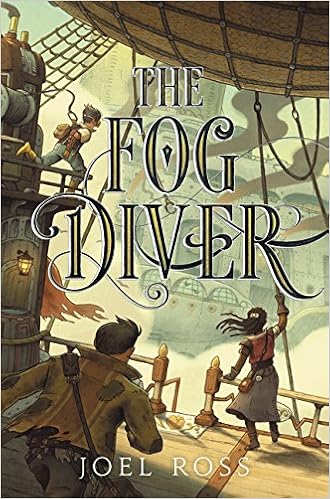
The Fog Diver describes a post-apocalyptic world where everyone travels by airships above the deadly Fog that covers the planet. Airships that are straight from a steam-punker’s dream; half blimp, half machine, with engines, valves and a pipe organ to steer it. All the markers of a perfect YA novel are there: danger, friends that stick closer than family, an evil villain and room for a sequel.
I checked it out of the library, but forgot about it until got the reminder email that my books were due, today. I figured I’d be able to renew it, so didn’t take it with me. The librarian informed me someone has it on hold (good for them!). I bit my lip, trying to remember how long the book was, and said, ‘I think I can read it tonight’. She was sweet and reminded me I had a day of grace and that the library was closed on Sunday, so I could really have the weekend, as long as I returned it by Monday. Or, I could keep it till I’d finished and pay the .25 cents a day fine. “I’ll read it tonight,” I said with a smile. And I did. Well, almost. At 11pm I finally closed it, tantalizingly close to the finish. I was able to get the last few chapters read in the morning.
It was fantastic, except...except that I’m not twelve anymore and I notice things. I notice what is there and what isn’t there. There was a lot of dialogue. The book is mostly dialogue, with no paragraphs of description. When there is non-dialogue description it is actually the thoughts of Chess, from whose point of view we see the world. When the author needs to give backstory he has a character ask a question and one or two other characters interrupt each other to give the story of why or where or how. It ends up feeling choppy, especially after the flowing, lyrical sentence I have been reading by E.B. White, L’engle, and Elizabeth George Speare. Do kids even know what good reading reads like anymore?
I also ended up liking one of the supporting characters more than the main character. The book is written from Chess’ point of view, but Bea, the spunky ‘gearslinger’ who talks to the airship’s engines and treats her machines like people, ends up being the one my heart goes towards. The plot takes precedence over full-bodied characters. The characters are not fully fleshed out, but rather stereotypical (the mutineers who suddenly turn into our hero’s best friends).
This novel has been nominated and shortlisted for a couple of awards including the Great Stone Face Award List, and I do feel that it is a good book. Perhaps it lands in the category of “empty-calorie” books. As Katherine Paterson writes in The Invisible Child,
“We can’t snatch these empty-calorie books from our children’s hands, indeed, that would make them all the more desirable, but somehow we must make sure early on that they have books that will truly nourish them, that will enlarge their minds, that will prepare them to make wise and compassionate decisions when they are grown” (p. 94).
So don’t snatch this book away, snatch it for you child (or you!) and read it, in a sitting, in a day, in a week. It is good, like cake and ice-cream good. Just make sure you also read the 'meat and potatoes', something more substantial, something that will stretch your mind and fill you up with good writing.
Picture from www.amazon.com, cover art is copyrighted.
The Fog Diver describes a post-apocalyptic world where everyone travels by airships above the deadly Fog that covers the planet. Airships that are straight from a steam-punker’s dream; half blimp, half machine, with engines, valves and a pipe organ to steer it. All the markers of a perfect YA novel are there: danger, friends that stick closer than family, an evil villain and room for a sequel.
I checked it out of the library, but forgot about it until got the reminder email that my books were due, today. I figured I’d be able to renew it, so didn’t take it with me. The librarian informed me someone has it on hold (good for them!). I bit my lip, trying to remember how long the book was, and said, ‘I think I can read it tonight’. She was sweet and reminded me I had a day of grace and that the library was closed on Sunday, so I could really have the weekend, as long as I returned it by Monday. Or, I could keep it till I’d finished and pay the .25 cents a day fine. “I’ll read it tonight,” I said with a smile. And I did. Well, almost. At 11pm I finally closed it, tantalizingly close to the finish. I was able to get the last few chapters read in the morning.
It was fantastic, except...except that I’m not twelve anymore and I notice things. I notice what is there and what isn’t there. There was a lot of dialogue. The book is mostly dialogue, with no paragraphs of description. When there is non-dialogue description it is actually the thoughts of Chess, from whose point of view we see the world. When the author needs to give backstory he has a character ask a question and one or two other characters interrupt each other to give the story of why or where or how. It ends up feeling choppy, especially after the flowing, lyrical sentence I have been reading by E.B. White, L’engle, and Elizabeth George Speare. Do kids even know what good reading reads like anymore?
I also ended up liking one of the supporting characters more than the main character. The book is written from Chess’ point of view, but Bea, the spunky ‘gearslinger’ who talks to the airship’s engines and treats her machines like people, ends up being the one my heart goes towards. The plot takes precedence over full-bodied characters. The characters are not fully fleshed out, but rather stereotypical (the mutineers who suddenly turn into our hero’s best friends).
This novel has been nominated and shortlisted for a couple of awards including the Great Stone Face Award List, and I do feel that it is a good book. Perhaps it lands in the category of “empty-calorie” books. As Katherine Paterson writes in The Invisible Child,
“We can’t snatch these empty-calorie books from our children’s hands, indeed, that would make them all the more desirable, but somehow we must make sure early on that they have books that will truly nourish them, that will enlarge their minds, that will prepare them to make wise and compassionate decisions when they are grown” (p. 94).
So don’t snatch this book away, snatch it for you child (or you!) and read it, in a sitting, in a day, in a week. It is good, like cake and ice-cream good. Just make sure you also read the 'meat and potatoes', something more substantial, something that will stretch your mind and fill you up with good writing.
Picture from www.amazon.com, cover art is copyrighted.
15 June 2016
Making A Start
By chance I picked up Katherine Paterson’s book The Invisible Child: On Reading and Writing Books for Children at the library. Isn’t that how all great book recommendations start? The best books are the ones you aren’t looking for, that you don’t know you even need to read. This is definitely on of them. The Invisible Child is a collection of speeches and talks that Paterson has given ranging from 1974 into the 2000s. It contains her Newbury and National Book Award speeches as well as a number of other talks from conferences.
This book has been stirring me to read the books I was inspired by as an adolescent. What books captured my attention, my mind, my heart when I was nine or ten years old? So I have returned to the books I have kept since childhood. Faithfully packing and unpacking through several moves. Books I can not get rid of, no matter how many yard sales I have. It’s not that I have good memories of these books, no, these books are my memories. So I have been gobbling up the Newbury Award winners of my youth: Katherine Paterson, Margeurite Henry, Elizabeth Enright, Elizabeth George Speare. I am trying to learn from them. Study their style, rhythm, what makes their characters so relatable and memorable. What is the rhythm of their sentences? How does the story unfold? I want to learn from these masters, mentors, but without copying. Of course, I’m also enjoying just reading them.
As I re-read these cherished books, Katherine Paterson’s words ring true, “There is something so comforting about the beloved books of childhood. When the uncertainties of life assail us, they stand as healing verities, and we can return to them again and again. But only, of course, if someone helped us to find those books when we were very young” (95).
That’s what I want to write. A book that captures that young imagination and tells that shy, introverted child there is adventure out there, or at least in here, between the pages. Life may be a bit boring and monotonous, but you can escape into a book filled with adventure and new worlds.
So I have made a start. First by filling my head with rich words from amazing authors, then by actually writing down the stories that are running through my head. We shall see what adventure awaits...
This book has been stirring me to read the books I was inspired by as an adolescent. What books captured my attention, my mind, my heart when I was nine or ten years old? So I have returned to the books I have kept since childhood. Faithfully packing and unpacking through several moves. Books I can not get rid of, no matter how many yard sales I have. It’s not that I have good memories of these books, no, these books are my memories. So I have been gobbling up the Newbury Award winners of my youth: Katherine Paterson, Margeurite Henry, Elizabeth Enright, Elizabeth George Speare. I am trying to learn from them. Study their style, rhythm, what makes their characters so relatable and memorable. What is the rhythm of their sentences? How does the story unfold? I want to learn from these masters, mentors, but without copying. Of course, I’m also enjoying just reading them.
As I re-read these cherished books, Katherine Paterson’s words ring true, “There is something so comforting about the beloved books of childhood. When the uncertainties of life assail us, they stand as healing verities, and we can return to them again and again. But only, of course, if someone helped us to find those books when we were very young” (95).
That’s what I want to write. A book that captures that young imagination and tells that shy, introverted child there is adventure out there, or at least in here, between the pages. Life may be a bit boring and monotonous, but you can escape into a book filled with adventure and new worlds.
So I have made a start. First by filling my head with rich words from amazing authors, then by actually writing down the stories that are running through my head. We shall see what adventure awaits...
12 November 2012
My Very First "Con"
Convention that is, or was it a conference. Still not clear on that, but I was there at AnthoCon 2012 (you can add the synthesizer echo in your head). Overall I'm glad I went. I'm also glad I didn't spend money on it, or at least not really.
Last March I won tickets at my school's silent auction. I was the only bid. So for $40 I won four tickets. I didn't really know what they were tickets for, neither did other bidders I think, but as a teacher we make sure all items get bids. Eight months later I still didn't know what I was in for and the website wasn't very helpful in telling me what I wanted to know. In my typical style I didn't google what 'speculative fiction' was until last night and it turns out I've read a ton in that genre.
The conference, or maybe convention, was interesting. It was encouraging and depressing at the same time. Encouraging because I see that I have time. If I am diligent and write like crazy now, some day when my life doesn’t include toddlers and grad classes I can put in the time and effort to getting published. The authors on the New Writers Panel had been writing “their whole lives” but had only been published in the last 5 years. They were all at least 10 years older than me. Okay, so I have time. But, there are already so many authors and only more to come. And the future is ebooks (bleh) and no one will want to put my book on a bookshelf. It’s depressing because it’s all been said before and if I wait, anything I had to say will be said by the time I’m ready to seek out publishing.
So really the question becomes ‘why do I write?’ There’s a big part of me that writes for recognition (I think that is true of many writers, and really of everybody in whatever field they are in - why do athletes want to go pro? Why do crafters start blogs?) But I know I write for me. I write because there are words in my head and I can’t retain them. If I don’t write them down I will loose them. I write because to keep it all inside would make me crazy. Though from the outside I might already look like I’m crazy because I talk to myself so much (gotta get those words out).
I went into the conference claiming I knew nothing about speculative fiction. Seeing the blood-spattered gothic book covers and plethora of black clothing seemed to confirm my view. But really speculative fiction was largely what I read growing up. Besides the more recent pop-hits Twilight and Hunger Games, there’s Frank Peretti and George McDonald, not to mention Lewis and Tolkien. Madeleine L’Engle for crying out loud - one of my favorite authors of all time. Fairy tales, all books by Robin McKinley, old English lore - King Arthur, Merlin - all fall under the vast umbrella of speculative fiction. AnthoCon leaned heavily towards the horror/thriller genre with a little bit of paranormal romance (I don’t want to ever go there), but according to one of the founders they are hoping for it to expand, for the other genres of speculative fiction to be included soon.
The most important piece of advice from the whole weekend: if I put it on my blog it is self-published and a publisher won’t want it.
I can hear that nap time is over, which means so is my time to write....at least for now.
26 October 2012
Being A Real Writer
A writing mentor gave me a book last Sunday. She said its a book she's found helpful in her writing and wanted to pass on a copy to me. Writing Down the Bones: Freeing the Writer Within by Natalie Goldberg. I've been in a writing funk for a while (hence no posts), and this was exactly what I needed. I was at class all day today and, for some wonderful reason, had brought the book with me. I read a bit at lunch. Here are my thoughts after the first chapter:
This woman knows me. Did she sneak into my head? Thoughts I’ve never acknowledge, possibly didn’t know I had and she is writing about it. Every sentence is ‘yes’ or ‘oh dear, so true’. Even the title: Freeing the Writer Within. My writer is trapped, shackled by dirty dishes, spit-flecked mirrors and a whiney dog.
How many times have I stood in a stationary store, handling the journals and notebooks? Paging through, feeling the cover, feeling the weight of the page, does it fit right, does it feel right. Switching pens, fancy, plain, blue ink, black ink, not a fan of rainbow ink. Heavy pens, light pens, fat pens, thin pens. I’ve written on steno notebooks, blank-sheeted sketch pads, wishing for an old-fashioned typewriter rather than a computer because that would make me feel more like a writer. I would be a real writer if I could use a typewriter. Spending tons of money finding an old typewriter, keeping it working, searching the internet for supplies. Would Pete be able to fix it if it broke? Dealing with correction tape and white out instead of a delete key. That would make me a real writer.
When I write on the computer I feel I should be writing with pen and paper. That’s how to really write. Goldberg even says this: Handwriting is more connected to the movement of the heart. See, I should write longhand. It’s more creative. I need more journals. Journals that are all the same, lined up on the shelf years from now with the dates on the spine. A collection of my ideas. My life’s work. My masterpiece of ... Of what? What do I really write? No one would read that. Well, my biographer will have to wade through all the random thoughts to find the nuggets of actual writing. But how will they do that if I type everything. I have to write with pen and paper. That would make me a real writer.
And then there’s the business of where to write. Do real writers write in cafes with endless supplies of caffeinated beverages? Do real writers cloister themselves away in attics? I need an attic. I can’t be a real writer unless I climb a rickety staircase to the top of a house. I must not be a real writer, I live in a ranch.
I didn’t want to call the third bedroom the office. What a boring name. Yes it has books, a desk, computer, printer, etc. But I wanted to call it the ‘den’. It’s a better name. A name that brings to mind coziness. A writerly name. I can write in a place called the ‘den’. I can’t write in a place called the ‘office’. Maybe I should be calling it the ‘studio’. Do writers have studios? A studio means creativity and inspiration. A room called a studio doesn't have to be at the top of a flight of stairs. (Although, you could say our den is at the top of the basement stairs.) I sew in that room too. Maybe I should call it my studio. That would make me a real writer.
19 January 2012
A Piece of Writing is Never Finished
I started re-reading Lord of the Rings and because I was reading on my kindle I ended up reading the bits at the beginning "Notes on the Text". I usually just skip past introductions and forwards except in Lit class when we had to, or I could use it as a source for an essay. But I didn't skip this one and I learned something new. Tolkien was plagued by misprints (the editors 'corrected' his writing by changing dwarves to dwarfs and elvin to elfin, among others) and he rewrote vast parts of the book each time it was reprinted. For over 10 years he rewrote parts of the novel (it is really one long book in 3 volumes, not a trilogy). So with Tolkien as my example I decided to revise my last post. I had written it quickly, trying to get it up before the game got too embarrassing. So here is a revised version. Sometimes revision comes quickly: cutting and slicing at unnecessary words; other times it is slow going, reading the sentences over and over hoping for inspiration on how to make it cohesive. Usually the difference is whether I like the piece or not. I didn’t particularly like this one, both because I rushed it and because we lost. But I did find I answered the question differently after thinking about it more.
When I was a kid, Psalty the Singing Songbook sang to ‘do your best and let God do the rest’. To my six year old self that meant making half my bed and letting God do the rest. Obviously that didn’t work. Now I understand it a little differently. It is the paradox of knowing that God has given me the ability to accomplish something and also completely relying on Him for my strength, for without Him I am thoroughly inadiquate. God does want us to do our best with what He has given us. But He also promises to never leave us or forsake us.
There have been a lot of comments about God not caring about football and that He has a lot more important things to do then help the Broncos win football games. But is that really true? Does God care about football? I pray before I go to work. There are many things that try my patience as a teacher so every morning I pray for patience. Patience for the children, for my co-workers, for myself when I make mistakes that seem inevitable. Yes, God has given me compassion for children and talent to work with them; but I still need His help to get through a day sometimes. Is Tebow praying before the game any different from me praying for patience before I go into school? He is using his God given talent in the career he has chosen and praying for God to be glorified through it. What could be more important to God than one of His children asking for His strength to walk out the path He has set?
Given that, I now say yes, God does care about football. Because His creation is involved. We are His creation and God cares about people. He cares about Tim Tebow (Tom Brady too for that matter). He loves Tim Tebow (and yes, Tom Brady too). Not because they win or loose football games but because they are His creation. He loves them just because. Perhaps the more important thing God has to do than helping the Broncos win football games is reveal Himself to the high school quarterback who is hearing Tim Tebow glorify God. God doesn’t leave Tim Tebow just because he steps on a football field. God is his strength no matter what he is doing.
So before the game I prayed for Tebow. I prayed that whether he wins or not he would watch his character most of all. Win or loose that he would feel the love of Jesus. That he would be able to focus and do his best when needed. But most of all that win or loose, Jesus would be glorified.
Would God say He loves football? No, He would say He loves you.
11 January 2012
The Throws of Essay Writing
I'm sorry for the lack of a post recently. Five papers due this weekend has depleted my motivation to write. Here is something I wrote a little while ago, when I couldn't think of something to write.
I’m trying to write. Trying to be inspired, to find that perfect prompt that will shoot me into my next story; but I am chasing shadows. There is no perfect prompt. It is an illusion made up by writing books and authors who have “made it”. ‘It just came to me’ they say nonchalantly. ‘I dreamed about that character’ they might add. ‘The story has been rattling around in my head for ages and my friends always said it would make a good book’ another might quip.
And then there’s me. Apparently the only writer who doesn’t dream her characters into being during the night; full, robust beings by the time the kettle whistles. No story rattles around my head. No well meaning friends are begging me to put a story to paper (the begging goes in a slightly different direction). This isn’t writer’s block. Writer’s block implies that there is writing that is being blocked. This is writer’s – see, I can’t even come up with an analogy to what I am going through – blank. The complete absence of anything to write about; characters, setting, description, dialogue would all be lovely but I first need a subject. The point of the story, the plot line needs to have its start somewhere. First line, last line, middle of the story – I’ll start anywhere if I could just think of something to start with. (And now I can’t even compose a sentence properly, ending with a preposition – shameful.)
So here I am doing one of the very things I detest because I cannot think of anything else to write. I am writing about writing. I detest it because writing is such a personal experience. So what if big shot, New York Times Bestselling author uses a five inch by nine inch blue cloth bound journal that cost $9.95 and has blank pages with character traits listed on even pages and setting descriptions on every other odd page with plot outlines on the remaining odd pages. It’s just not me. Not that I don’t like the color blue (which I do) or that making lists of things is bad idea. But writing is personal. I do it my way. You do it yours. Just because my fiction professor says he only uses a single notebook (four inches by three inches, black with an elastic band) for everything, from grocery lists to chapters of his novel, doesn’t mean that I must consolidate my writing journal, a sketch book (makes me feel artsy) with the wire spiral at the top and a yellow cover; my (hmm, was about to call it deep thoughts journal but not so much) personal thoughts journal which includes my Bible notes, and the journal of ‘crazed in-the-moment thoughts and poems’ on my computer. They do not have to become one. Why? Because I don’t want them to. I like having multiple journals. Skipping from one to another enhances my writing (at least that’s what I tell myself). To be honest, there have been times when I have wished I didn’t have to lug three separate journals half way around the world just to record my thoughts. But I suppose if I were to do otherwise I would not be staying true to myself.
Even with all my journals I can’t think of anything to write, but here goes. There once was a girl. (How original.) Where does she go? Whom does she meet? I DON’T KNOW I HAVE WRITER’S BLOCK!
Subscribe to:
Posts (Atom)